



How will Hyundai’s €150 million Square Campus in Rüsselsheim transform car testing in Europe
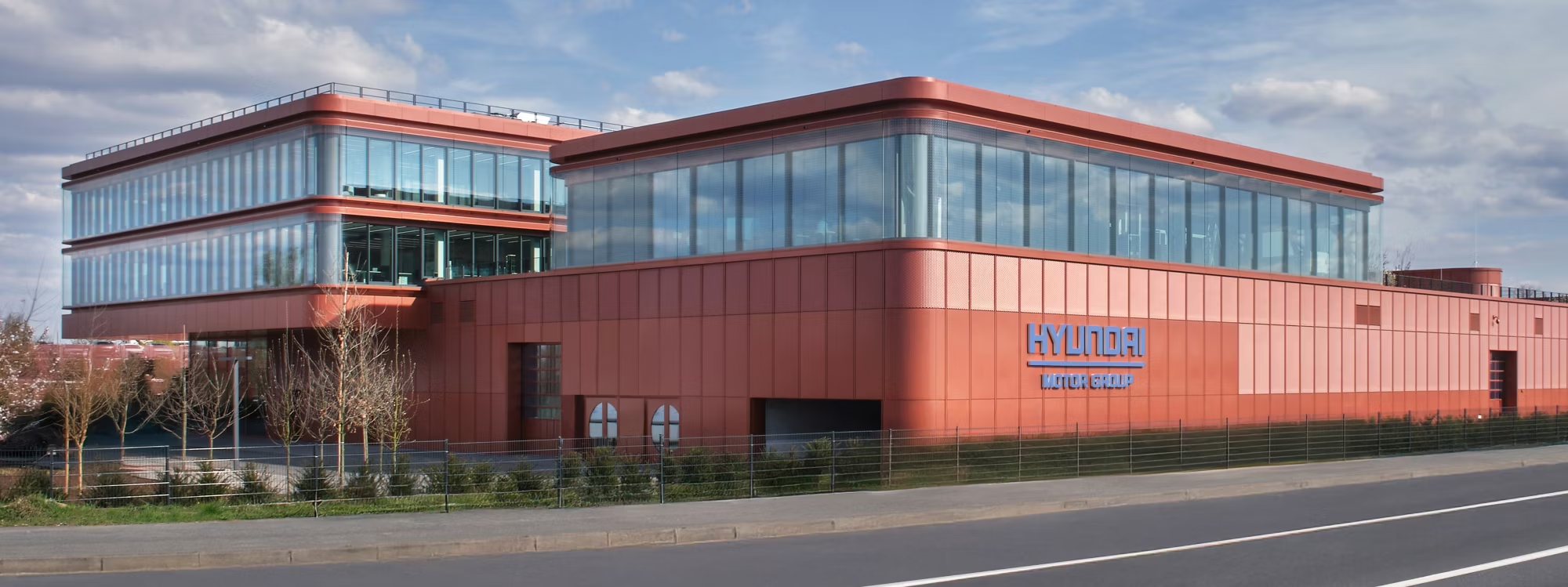
A new chapter in European automotive innovation is taking shape in Rüsselsheim, Germany, where Hyundai Motor Group has unveiled its groundbreaking “Square Campus” — a €150 million state-of-the-art research, testing, and development centre that underscores the brand’s strategic commitment to Europe’s mobility future.
Spanning 25,000 square metres, the new facility enables precision testing of vehicles, powertrains, and electronic systems under fully controlled laboratory conditions — from extreme heat and humidity to sub-zero cold and heavy rain. This allows Hyundai engineers to simulate real-world driving environments and fine-tune the next generation of electric, hybrid, and combustion models to meet the strictest European standards for safety, efficiency, and comfort.
Representing one of the largest R&D investments by a non-European car manufacturer in Germany in the past decade, the Square Campus strengthens Hyundai’s position as a pioneer in sustainable mobility, electric vehicle innovation, and advanced automotive engineering — a tangible step toward the company’s carbon-neutral vision for 2045, NewsToday24 reports, citing Hyundai News Europe.
What makes the Square Campus unique
The new facility integrates some of the most advanced testing environments in Europe:
- Charging Laboratory: simulates fast-charging behaviour of electric vehicles across diverse grid and climate conditions, essential for next-generation EVs.
- Driving Simulators: recreate real-world dynamics, steering response and road surfaces, enabling engineers to test driver assistance systems and software calibration.
- NVH and Electromagnetic Chamber: a fully shielded semi-anechoic chamber where noise, vibration and harshness are analysed with millimetre precision, even under electromagnetic isolation.
- Weather-independent test zones: allow performance analysis of combustion, hybrid, and electric powertrains without outdoor interference.
These features make the Rüsselsheim site one of Hyundai’s most advanced global testing environments — a key element in its mission to deliver safer, quieter, and more efficient vehicles to European customers.
“This investment clearly shows Hyundai’s long-term commitment to Europe,” said Tyrone Johnson, Head of the Hyundai Motor Europe Technical Center (HMETC). “The Square Campus will help us develop cars that meet the expectations of European drivers in every detail.”
Employment and regional importance
The HMETC now employs over 500 specialists, a workforce increase of more than 20 percent compared with last year. Hyundai’s continued growth contrasts with the regional downturn, where Segula Technologies GmbH — a former Opel engineering provider — has filed for insolvency and closed test centres in Rodgau-Dudenhofen and Rüsselsheim, cutting nearly 300 jobs.
Hyundai’s decision to expand demonstrates confidence in Germany’s engineering base and underlines Rüsselsheim’s position as a core European hub for vehicle innovation.
Sustainability and technology focus
The Square Campus follows Hyundai’s sustainability standards:
- Solar energy generated by photovoltaic panels supports daily operations.
- Heat-pump systems reduce CO₂ emissions.
- Recycled and eco-certified materials were used in construction.
Engineers will focus on electric mobility, autonomous driving, ADAS, OTA updates, and vehicle cybersecurity — all areas vital to Hyundai’s strategy for carbon-neutral mobility by 2045.
“We are merging Korean innovation with European precision,” Johnson noted. “Every prototype we test here brings us closer to smarter, cleaner mobility.”
A European network for next-gen mobility
The Square Campus complements Hyundai’s other European testing facility at the Nürburgring, where high-performance and endurance tests are carried out. Together, they form a dual network that covers both laboratory precision and real-world performance, giving Hyundai a full spectrum of testing capabilities across the continent.
Industry analysts see this as a crucial move for Hyundai to solidify its reputation as a technology-driven, European-focused brand. The company’s ongoing expansion reflects a wider strategy to compete head-to-head with German manufacturers not just in sales, but in engineering excellence and innovation capacity.
In summary, Hyundai’s €150 million investment in Rüsselsheim isn’t just about infrastructure — it’s a strategic statement. The new Square Campus stands as a symbol of the brand’s transformation from a value-driven automaker to a technology leader shaping the future of mobility in Europe.
Stay connected for news that matters — timely, factual, and free from bias. Read trusted updates from Berlin, Ukraine, and around the world with insights that help you understand what’s really happening. Learn more about this topic and related developments here: Grok 4.20 by Elon Musk: What’s Known About the New AI Release – Advantages, Risks
Foto - Hyundai Motor Group