



What Does a Kiss Under the Mistletoe Really Mean? History, Symbolism and Christmas Tradition

A kiss under the mistletoe is often treated as a playful Christmas cliché, yet its meaning is far older and far more deliberate than modern holiday culture suggests. Long before it became associated with romance, mistletoe functioned as a powerful social symbol tied to peace, protection and transition. The act of kissing beneath it was never random; it followed shared cultural rules that defined consent, reconciliation and renewal at a key moment of the year, reports the editorial team of NewsToday24.
From a botanical perspective, mistletoe usually refers to Viscum album, an evergreen plant that grows on trees rather than in soil. Its unusual way of growing — suspended between sky and ground — made it deeply symbolic in early European societies. Remaining green throughout winter, mistletoe represented continuity of life during the darkest season, elevating it beyond ordinary decorative plants.
The earliest documented significance of mistletoe appears in Celtic tradition. Druids considered it sacred, particularly when found growing on oak trees. Roman writer Pliny the Elder described ritual mistletoe harvesting ceremonies involving golden sickles, underlining the belief that the plant possessed protective and harmonising properties. In this context, mistletoe was not ornamental but functional, believed to influence balance within the community.
Norse mythology further shaped mistletoe’s symbolic role. In the myth of the god Baldur, mistletoe caused his death — a story later reinterpreted to transform the plant into a symbol of reconciliation rather than destruction. From this narrative emerged the idea of mistletoe as a pledge of peace, a meaning that would later be expressed through ritualised gestures rather than violence.
Originally, a kiss under the mistletoe carried no romantic implication. It served as a recognised social signal. In several traditions, individuals who met beneath mistletoe were expected to observe a truce. The kiss symbolised agreement, goodwill or the resolution of conflict. Romance became attached to the custom only centuries later, as social norms evolved.
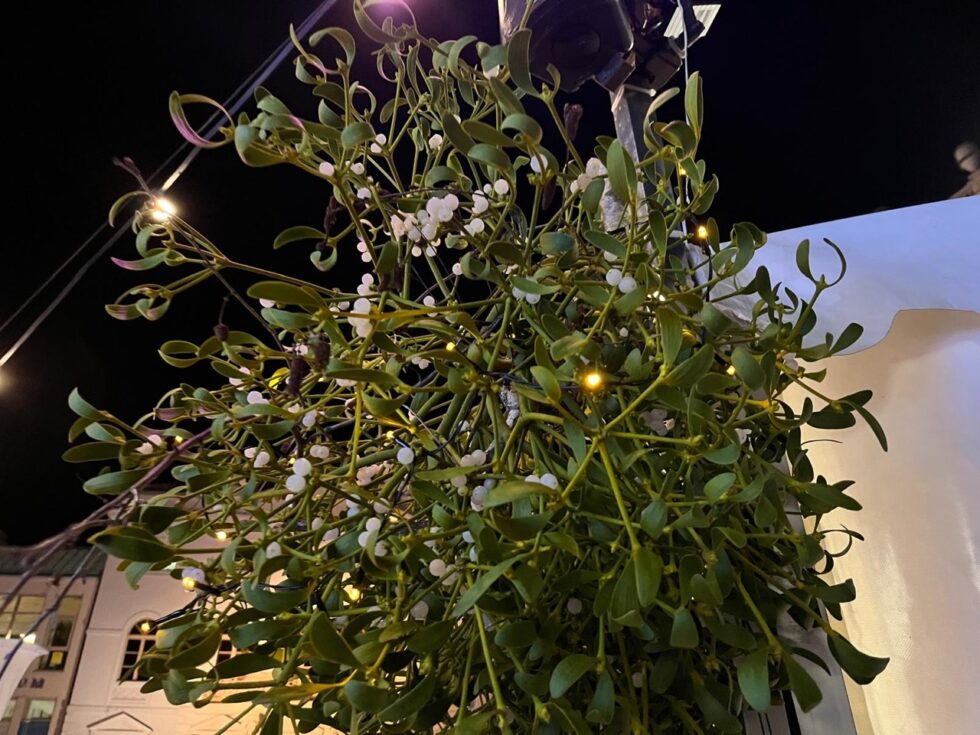
The association between mistletoe and Christmas developed primarily in England during the 18th and 19th centuries. Victorian society formalised the tradition and introduced explicit rules. A sprig of mistletoe was hung in a doorway, and each kiss required the removal of a white berry. Once all berries were gone, the mistletoe lost its symbolic power. This structure shows that the custom was governed by limits and meaning, not spontaneity.
Placement remains central to the ritual’s significance. Mistletoe is traditionally hung over doors, arches or passageways — locations that symbolise transition. A doorway represents movement from one state to another: from outside to inside, past to future, separation to connection. A kiss beneath mistletoe therefore marks a conscious crossing rather than a casual interaction.
In modern popular culture, films and advertising have simplified the tradition into a romantic trope. Yet its deeper logic remains intact. A kiss under the mistletoe still implies mutual consent and shared recognition of a symbolic moment. It creates a socially accepted space where closeness is permitted without explanation, which helps explain why the ritual survives in societies with fewer shared customs.
Contemporary use of mistletoe follows several unwritten conventions. Artificial mistletoe is often preferred due to environmental protections. It is displayed only during the Christmas season and removed afterward, reflecting older beliefs about balance and closure. Above all, participation is voluntary — a principle consistent with both historical tradition and modern social expectations.
The endurance of the mistletoe tradition lies in its clarity. It functions as a precise cultural signal rather than vague symbolism. By marking peace, transition and human connection at a time devoted to reflection and renewal, the kiss under the mistletoe continues to hold relevance well beyond its festive appearance.
Stay connected for news that works — timely, factual, and free from opinion — and insights that matter now: How to Use Your Contrast Shower for Health, Immunity and Mental Strength