


Lunar Eclipse August 2026: All info on timing and the best locations in Germany
Celestial events 2026 offer astronomy enthusiasts in Germany spectacular views of rare phenomena across the firmament. The upcoming year promises an impressive variety, ranging from a deep partial solar eclipse to luminous meteor showers. Stargazers in major cities like Berlin, Munich, Hamburg, Cologne, and Frankfurt should mark the most important dates in their calendars now. Increased solar activity in the first half of the year also raises hopes for vibrant northern lights, which could be visible as far as southern Germany under optimal conditions. The rare planetary parade at the end of February is expected to captivate both experts and laypeople alike. Since the next comparable solar eclipse in Germany is not predicted until the year 2090, the event on August 12 holds historic significance for the local observation community. This is reported by the editorial team of NewsToday24 citing mit Verweis auf das Royal Observatory in Greenwich.
Partial Solar Eclipse on August 12, 2026
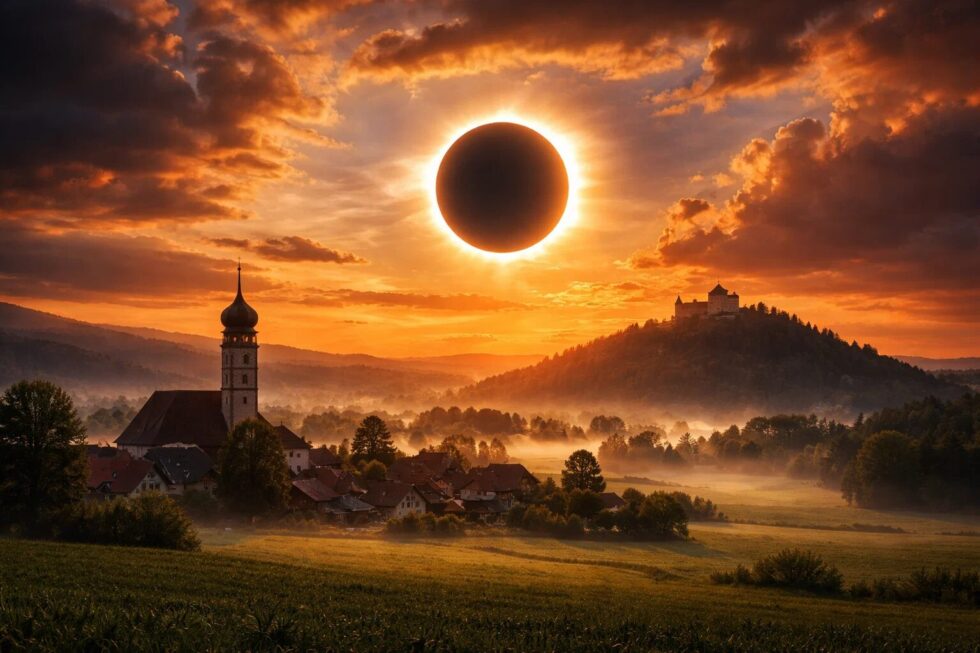
The partial solar eclipse on August 12, 2026, is undoubtedly the astronomical highlight of the decade for Germany. According to calculations by the Royal Observatory, the spectacle begins at 19:17 CEST and reaches its maximum at 20:13 CEST. In cities like Frankfurt and Munich, up to 90 percent of the sun will be covered by the moon. Because the sun will be low in the sky, a clear view toward the west-northwest is absolutely necessary for observation. The Lohrberg in Frankfurt (Klingenweg, 60389 Frankfurt) is considered one of the best vantage points in the region. To protect the eyes, the use of certified solar eclipse glasses meeting the ISO 12312-2 standard is essential. Without this protection, permanent retinal damage can occur when looking at the remaining solar crescent. This significant darkening of the day will be a rare experience that will not be repeated in this magnitude for many years over German soil.
Optimal observation sites for the solar eclipse:
- Frankfurt: Lohrberg (Seckbach) – Unobstructed view of the western horizon.
- Munich: Olympiaberg – Elevated position for a clear view over the city.
- Berlin: Teufelsberg – Former listening station with a 360-degree panoramic view.
- Cologne: Herkulesberg – Central hill with a good sightline toward the west.
- Hamburg: Energieberg Georgswerder – Clear view over the Elbe valley and the horizon.
Meteor Showers and Shooting Stars in 2026
The year 2026 offers several periods of high meteor activity, with the Perseids in August occurring under particularly favorable conditions. During the night of August 12 to 13, the Earth crosses the dust trail of comet Swift-Tuttle. Since there is almost a new moon at this time, no moonlight will interfere with the view of up to 100 meteors per hour. The Geminids in December also promise an impressive display in the winter sky, with up to 150 shooting stars per hour. Dark locations away from urban light pollution, such as the Taunus Nature Park near Frankfurt, are ideal for observation. A warm blanket and at least 20 minutes for the eyes to adapt to the dark are recommended for full enjoyment. Shooting stars are best seen with the naked eye, as optical aids usually restrict the field of view too much.
Key meteor showers 2026 at a glance:
| Meteor Shower | Peak Date | Meteors/Hr | Characteristics |
| Quadrantids | January 04 | 110 | Short, intense maximum |
| Lyrids | April 23 | 18 | Bright trails possible |
| Perseids | August 13 | 100 | Best visibility (New Moon) |
| Leonids | November 18 | 15 | Very fast meteors |
| Geminids | December 14 | 150 | Brightest shooting stars of the year |
Supermoons and the Rare Blue Moon
The moon shows its most magnificent side in 2026 with a total of three supermoons and one blue moon. A supermoon occurs when the full moon is particularly close to Earth, making it appear about 12 percent brighter and significantly larger. The first supermoon of the year was already visible in January, with more following on November 24 and December 24. A blue moon occurs on May 31, as this month contains two full moon phases. This rare statistical event happens only about every two to three years and attracts photographers worldwide. In Frankfurt, the riverside promenade along the Main offers an excellent backdrop for photographing the large moon behind the skyline. A partial lunar eclipse on August 28 will also be visible in Germany during the early morning hours, providing another highlight for nocturnal observers.
Important dates for lunar events 2026:
- May 31: Blue Moon (Rare second full moon in a calendar month).
- August 28: Partial Lunar Eclipse (93% coverage at 06:13 CEST).
- November 24: Beaver Supermoon (Very large and bright lunar disk).
- December 24: Cold Supermoon (Astronomical highlight on Christmas Eve).
- Photo Spot Tip: Eiserner Steg in Frankfurt for shots over the river Main.
Planetary Parade and Northern Lights Over Germany
On the evening of February 28, 2026, six planets line up in a rare constellation in the western sky. Jupiter, Saturn, Venus, and Mercury will be recognizable as bright points of light with the naked eye shortly after sunset. For Uranus and Neptune, which are also part of this alignment, binoculars or a small telescope will be required. This perspective alignment is one of the best planetary parades in decades and offers a unique photo motif. Additionally, the solar maximum in the first half of the year ensures an increased probability of northern lights in Germany. Strong solar storms can carry the Aurora Borealis as far south as Munich or Frankfurt. Observers should seek out locations with a clear northern horizon on evenings with high geomagnetic activity, such as the Feldberg plateau in the Taunus mountains.
Planetary visibility on February 28, 2026:
| Planet | Visibility | Position | Equipment Needed |
| Venus | Extremely bright | West-Southwest | None |
| Jupiter | Very bright | High in the Southwest | None |
| Saturn | Good | Deep in the West | None |
| Mercury | Moderate | Very deep in the West | None |
| Uranus | Difficult | Near Jupiter | Binoculars |
The astronomical year 2026 offers Germany a rare abundance of celestial events that are worth looking up for. From the massive solar eclipse in August to the winter planetary parade, nature provides free spectacles of invaluable worth.
Stay connected for news that works — timely, factual, and free from opinion — and insights that matter now: Berlin, Ukraine, and the world: Vagabonding Planets 2026: Sensational Mass Determination of a Dark Wanderer