


Who Is Banksy and Is He Really Robin Gunningham? What Is Known About the Mysterious Street Artist
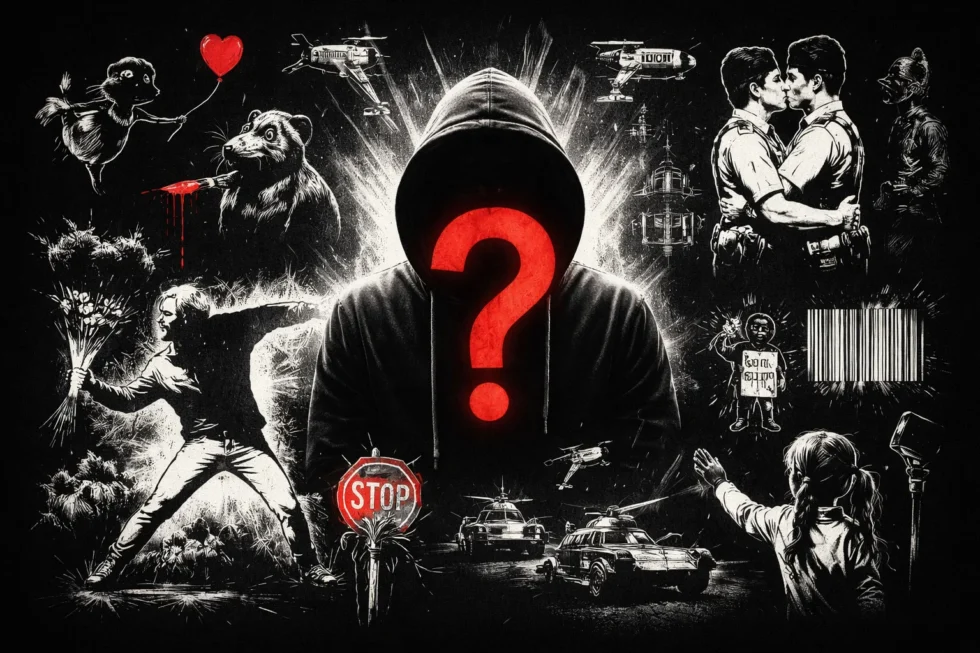
For more than two decades, Banksy has remained one of the most enigmatic and influential figures in contemporary art. His stencil-based murals appear unexpectedly on walls, bridges and buildings in cities around the world — from London and Paris to New York, Bethlehem and Kyiv. Within hours of a new work emerging, photographs circulate across international media and social networks, often triggering debates about politics, war, consumer culture, surveillance and social inequality.
Banksy’s art is widely recognized for its sharp political commentary and dark social satire. Many of his images address themes such as state power, economic inequality, migration, conflict and the role of media in shaping public perception. Despite the apparent simplicity of his visual language — typically monochrome stencil imagery combined with strong symbolic elements — his works quickly become global cultural references and widely discussed visual statements.
At the same time, the greatest mystery surrounding Banksy remains the identity of the artist himself. Despite worldwide fame, he rarely appears in public, almost never gives traditional interviews and has never officially confirmed his real name. This unusual contrast — maximum global visibility of the artwork alongside the complete anonymity of its creator — has transformed Banksy from a local graffiti artist into a powerful cultural phenomenon.
As NewsToday24 reports, citing reporting from The WP Times, the mystery surrounding Banksy’s identity continues to attract renewed attention as journalists and researchers attempt to trace the real person behind one of the most recognizable names in modern street art.
The Investigation Into Banksy’s Identity
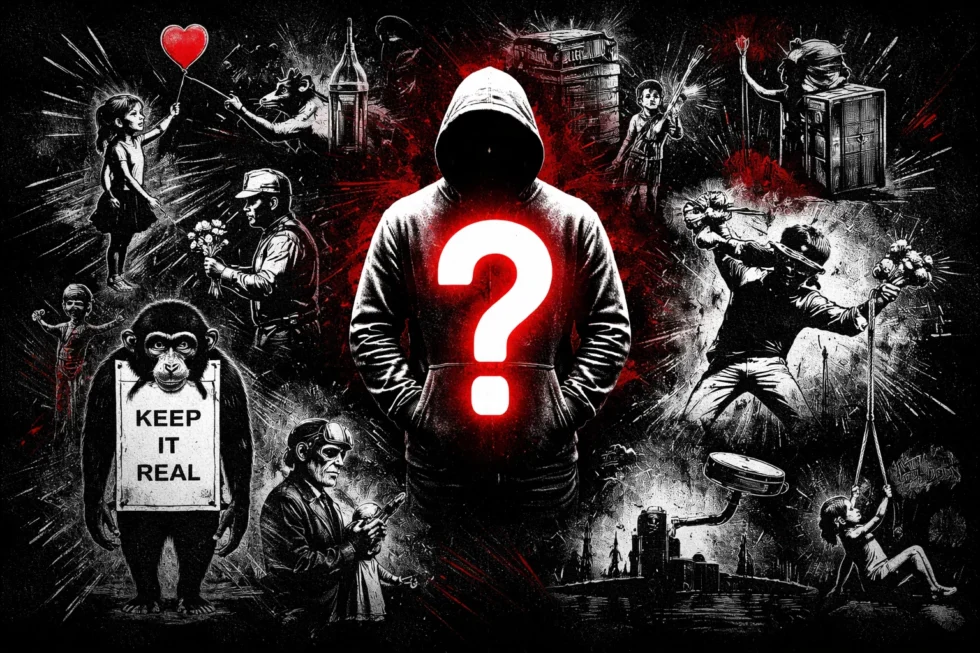
In recent years, the question of who is behind the Banksy pseudonym has again become the subject of journalistic investigations and public debate. Several investigations have pointed to Robin Gunningham, a man born in Bristol, United Kingdom, in 1973, as one of the most likely candidates to be Banksy. Researchers have analyzed archival records, photographs, court documents and travel patterns connected to people from the British underground art scene. According to some reports, Gunningham may also have used another name at certain points — David Jones. This could have helped him further conceal his identity and avoid media attention or potential legal issues related to unauthorized street art.
At the same time, Banksy’s lawyer Mark Stephens has stated that some information circulating in investigations may be inaccurate. He emphasized that anonymity plays an essential role in the artist’s work because it allows him to express political and social ideas freely.
Stephens also noted that Banksy’s anonymity shifts the focus away from the artist’s personal biography and toward the meaning of the artwork itself. In many countries, unauthorized graffiti may be considered vandalism, so anonymity also provides practical protection. Researchers have also observed correlations between travel patterns associated with Robin Gunningham and the appearance of Banksy artworks in various cities. Similar patterns have been identified in the United Kingdom, the United States and several European countries. While these parallels do not represent definitive proof, they have strengthened the theory that Gunningham could be the artist working under the Banksy name. Despite numerous attempts to uncover the mystery, Banksy’s identity has never been officially confirmed.
Why Robin Gunningham Is Linked to Banksy
The name Robin Gunningham first gained widespread attention in media reports around 2008, when journalists began comparing the biography of the Bristol-born artist with the timeline of Banksy’s early works. Investigations suggested that Gunningham:
- was born in Bristol in 1973
- attended Bristol Cathedral School
- developed an interest in graffiti during his teenage years
- was connected to Bristol’s underground art and music scene
Researchers also noticed that Gunningham’s movements during the 1990s appeared to coincide with the emergence of Banksy’s earliest murals in Bristol and London. Although these findings were not definitive proof, they significantly strengthened the hypothesis linking Gunningham to Banksy.
Bristol — The City That Shaped Banksy
Understanding Banksy’s work requires looking at the cultural environment of Bristol in the 1990s, where a vibrant underground art scene was developing. At that time Bristol became known for:
- graffiti and street art culture
- electronic music and trip-hop
- experimental visual art and photography
- political posters and street activism
The city was also home to the influential music group Massive Attack, whose visual aesthetic and political themes were closely linked to the wider creative culture of the city. Many art historians believe that Banksy’s style — combining humor, political commentary and minimalist visual language — emerged directly from this environment.
Famous Banksy Works Around the World
Over the years, Banksy has created numerous murals that became iconic examples of modern street art.
Notable Banksy Works
| Artwork | City | Country | Year | Description |
|---|---|---|---|---|
| Girl with Balloon | London | United Kingdom | 2002 | A girl reaching for a red heart-shaped balloon — one of Banksy’s most recognizable images. |
| The Mild Mild West | Bristol | United Kingdom | 1999 | A teddy bear throwing a Molotov cocktail at riot police. |
| Flower Thrower | Bethlehem | Palestine | 2003 | A protester throwing flowers instead of a stone. |
| Kissing Coppers | Brighton | United Kingdom | 2004 | Two police officers kissing — a commentary on tolerance and identity. |
| Mobile Lovers | Bristol | United Kingdom | 2014 | A couple embracing while looking at their smartphones. |
| Prisoner Escape | Reading | United Kingdom | 2021 | A prisoner escaping with a typewriter rope — referencing Oscar Wilde. |
| Season’s Greetings | Port Talbot | Wales | 2018 | A child catching “snow” that turns out to be industrial ash. |
Banksy and the Global Art Market
Although Banksy began as an anonymous street artist working on public walls, his works have gradually entered the highest levels of the international art market. Today original pieces attributed to Banksy regularly appear at major auction houses such as Sotheby’s, Christie’s and Phillips, where they can reach prices of several million dollars. What once emerged overnight as unauthorized graffiti has become highly sought-after collectible art, attracting the attention of museums, private collectors and investment funds interested in contemporary art.
One of the most remarkable moments in Banksy’s market history occurred in October 2018 during an auction at Sotheby’s in London. The artwork “Girl with Balloon”, one of Banksy’s most recognizable images, was sold for approximately £1.04 million. Immediately after the hammer fell, however, the audience witnessed an unexpected event: a hidden shredding mechanism concealed inside the frame activated and partially destroyed the painting in front of the bidders.
The dramatic act quickly became one of the most discussed events in modern art. The shredded work was later given a new title, “Love Is in the Bin,” and rather than decreasing its value, the incident significantly increased its cultural impact and market price. In 2021, the same piece was sold again at Sotheby’s for about £18.6 million, demonstrating how Banksy’s work continues to blur the boundaries between artistic performance, social commentary and the economics of the art market.
Today Banksy’s works circulate within a complex global ecosystem of galleries, auction houses and collectors. His art is authenticated through Pest Control, the organization established to verify genuine Banksy works. Because the artist operates outside traditional institutional structures, this authentication process plays a crucial role in determining whether a piece can legally enter the art market.
Will Banksy’s Identity Ever Be Revealed?
Despite years of speculation and numerous journalistic investigations, Banksy’s true identity remains officially unconfirmed. The name Robin Gunningham, a man born in Bristol in 1973, continues to appear most frequently in discussions about the artist’s possible identity. Several investigations have pointed to similarities between his biography and the early development of Banksy’s work, yet the artist himself has never publicly confirmed the claim.
At the same time, some researchers believe the Banksy phenomenon could involve more than one individual. According to this theory, Banksy may function as a small creative collective, with different members responsible for design, logistics and the rapid execution of murals in different cities. Such a structure could explain how new works sometimes appear in multiple locations around the world within a short time frame.
Legal considerations also contribute to the persistence of anonymity. In many countries unauthorized graffiti can be classified as vandalism or damage to property. Maintaining anonymity therefore allows the artist to continue working in public spaces without facing potential legal consequences.
However, many art historians argue that the mystery itself has become a fundamental part of Banksy’s artistic identity. The absence of a visible author shifts attention entirely to the message of the artwork. Viewers focus on the political or social statement embedded in each image rather than on the biography of the person who created it. In an era when many artists cultivate personal brands and public visibility, Banksy represents the opposite approach. By remaining invisible while allowing his work to circulate globally, he has created a unique cultural model in which anonymity amplifies influence. This paradox — a world-famous artist whose identity remains uncertain — may ultimately be one of the key reasons why Banksy continues to capture global attention.
Stay connected for news that matters — timely, factual, and free from bias. Read trusted updates from Berlin, Ukraine, and around the world: Samsung Galaxy S26 Ultra: AI, Privacy Display and power — why 2026 marks a turning point