



What to see in Basel, Switzerland: top attractions, costs, addresses and travel tips for visitors
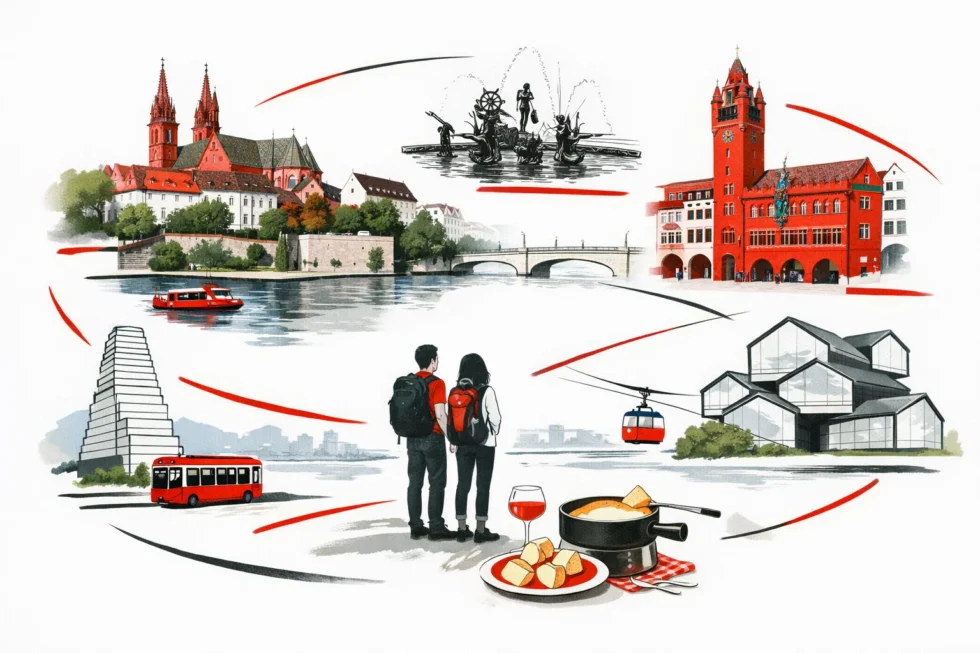
Basel travel demand in 2026 is rising due to its dense cultural infrastructure, cross-border positioning between Switzerland, France and Germany, and unusually high museum concentration per square kilometer, making it a compact but high-value European destination for short urban stays.
The city is structured around walkable cultural corridors, riverfront leisure zones and integrated public transport systems that reduce friction for tourists moving between major attractions. According to reporting compiled by NewsToday24 via baselpost.ch.
Why Basel Matters: What Makes the City Unique
Basel occupies a structurally unique position in European urban geography because it functions simultaneously as a Swiss cultural capital, a cross-border metropolitan node, and a high-density institutional museum ecosystem concentrated within a compact river-based layout.
The city’s significance is not derived from scale but from spatial efficiency: within a radius of roughly 2–3 kilometers, visitors encounter national-level museums, medieval architecture, corporate headquarters of global pharmaceutical companies, and one of Europe’s most active art fair infrastructures. This combination produces a hybrid urban model where culture, science, and commerce are not separated but co-located in the same central grid.
A second defining factor is Basel’s tri-national integration zone, where Switzerland, Germany, and France intersect in daily commuter flow. This creates a functional metropolitan region rather than a strictly national city system, with cross-border labor mobility, shared transport networks, and synchronized cultural calendars.
As a result, Basel operates less like an isolated Swiss destination and more like a trans-European interface city, where visitors can experience three regulatory, linguistic, and architectural systems within a single day trip radius.
The third structural advantage is the Rhine corridor, which acts as both an urban spine and a public leisure infrastructure. Unlike cities where riverfronts are primarily commercialized, Basel maintains a mixed-use approach: swimming zones, ferry crossings, cargo navigation, pedestrian promenades, and cultural venues coexist along the same water axis. This creates a layered urban experience where transport, recreation, and social life are continuously integrated rather than segmented.
Finally, Basel’s institutional density—particularly in art, design, and medical research—creates a long-term cultural gravity. The city hosts internationally significant events such as Art Basel and maintains permanent collections that position it among Europe’s top museum cities relative to population size. This institutional concentration explains why Basel is frequently selected for short cultural trips rather than extended tourism stays.
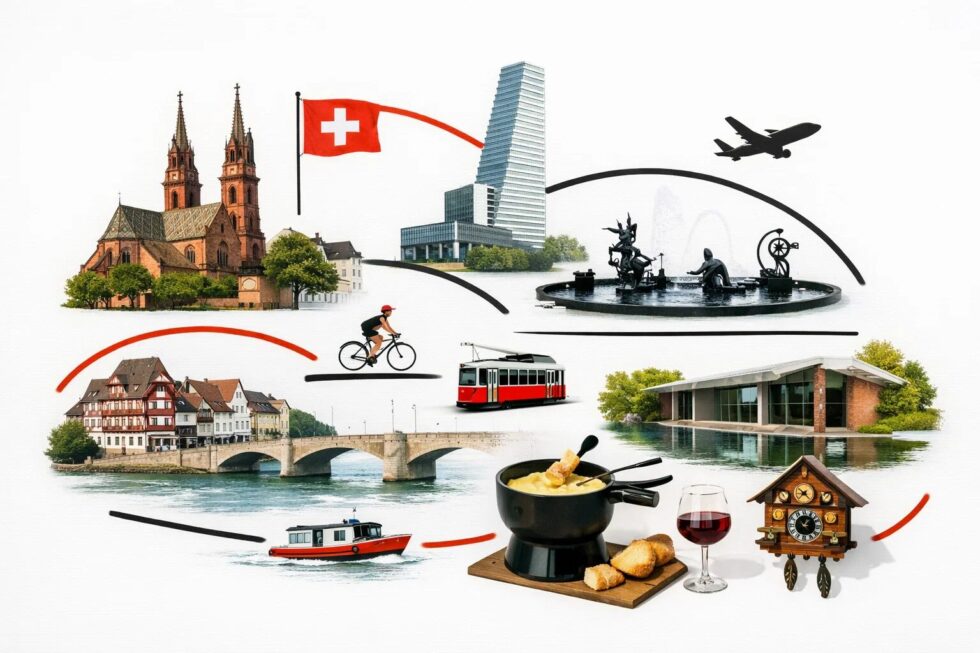
Basel Old Town and Rhine Riverside Walk
Basel’s Old Town is one of the most intact medieval urban cores in Switzerland, characterized by preserved guild houses, narrow alleys, and sandstone civic architecture that reflects centuries of merchant-based urban development.
The district is compact and fully walkable, with most key landmarks accessible within a 10–15 minute radius, which significantly reduces transport dependency for tourists. The Rhine riverside functions as an extension of the Old Town experience, where public life shifts toward open-air leisure, seasonal swimming, and informal social gatherings.
The area is also notable for its economic stratification, where high-end retail and traditional cafés coexist within the same pedestrian grid.
Address: Innenstadt, 4001 Basel, Switzerland
Entry: Free
Coffee: CHF 5–8
Walking route: Münster → Marktplatz → Rhine promenade
Typical stay: 2–3 hours minimum
Basler Münster Cathedral and Viewing Platform
The Basel Minster is a Gothic cathedral constructed from red sandstone between the 11th and 15th centuries, serving both religious and civic functions throughout its history. Architecturally, it is defined by its twin towers, asymmetrical spires, and elevated terrace overlooking the Rhine River, which provides one of the most structured panoramic viewpoints in the city. The tower climb involves a narrow stair system leading to a controlled viewing platform that frames both Old Town density and river curvature, making it a key orientation point for visitors.
Address: Münsterpl. 9, 4051 Basel, Switzerland
Tower entry: CHF 6
Highlight: Rhine + Old Town panoramic axis
Duration: 45–60 minutes
Access: Seasonal hours apply (weather-dependent)
Kunstmuseum Basel Art Museum Complex
The Kunstmuseum Basel represents one of Europe’s most historically significant public art collections, with institutional roots dating back to the 17th century.
Its collection structure spans three buildings, each dedicated to distinct curatorial layers: Old Masters, 19th–20th century modernism, and contemporary exhibitions. This separation allows for controlled thematic navigation rather than linear museum progression, which is common in older European institutions. The museum is also deeply integrated into Basel’s cultural economy, frequently collaborating with international galleries and biennials.
Address: St. Alban-Graben 16, 4051 Basel, Switzerland
Ticket: CHF 16–20
Duration: 1.5–2.5 hours
Collection scope: Holbein, Picasso, Cézanne, Basel School works
Operational note: Monday closures common
Tinguely Museum Kinetic Art Museum
The Tinguely Museum is dedicated to kinetic and mechanical art, focusing on the intersection of engineering systems and artistic expression through moving installations. The building itself is positioned along the Rhine, reinforcing thematic continuity between motion, water, and mechanical design.
Exhibits are intentionally interactive, requiring physical engagement from visitors, which differentiates it from conventional static museum environments. The institution plays a key role in Basel’s contemporary art identity.
Address: Paul Sacher-Anlage 1, 4058 Basel, Switzerland
Entry: CHF 18
Duration: 1–1.5 hours
Focus: kinetic sculpture, sound machines, interactive systems
Location note: Rhine waterfront access
Rathaus Basel Red Town Hall and Civic Square
The Basel Town Hall is a functioning government building located on Marktplatz and serves as the administrative center of the canton. Its architectural identity is defined by a deep red façade, ornate frescoes, and Renaissance-era detailing that visually distinguishes it from surrounding commercial structures.
The building is actively used for governmental sessions, which limits interior access, but the courtyard remains publicly open and frequently used as a transitional cultural space.
Address: Marktpl. 9, 4001 Basel, Switzerland
Courtyard: Free
Guided tours: CHF 5–10
Key feature: Renaissance fresco façade
Location context: central Marktplatz hub
Zoo Basel Zoological Garden “Zolli”
Zoo Basel is Switzerland’s oldest zoological institution and operates as a compact conservation-oriented facility rather than a large-scale zoological park. Its spatial design prioritizes habitat quality and visitor flow efficiency, allowing complete visitation within 2–3 hours.
The zoo participates in international breeding programs and emphasizes ecological education, particularly in species preservation. Its proximity to the city center increases accessibility compared to suburban zoological parks.
Address: Binningerstrasse 40, 4054 Basel, Switzerland
Ticket: CHF 22 adults
Duration: 2–3 hours
Key species: elephants, penguins, big cats
Transport: tram connectivity
Fondation Beyeler: Modern Art Near Basel
Located in Riehen, Fondation Beyeler extends Basel’s museum ecosystem beyond the city core into a landscaped architectural environment designed for immersive modern art presentation. The institution integrates natural surroundings with curated collections, producing a controlled viewing environment where architecture and landscape function as exhibition elements. Accessibility via tram ensures integration into standard tourist itineraries despite its peripheral location.
Address: Baselstrasse 101, 4125 Riehen, Switzerland
Ticket: CHF 25
Transport: 15 minutes by tram
Focus: Monet, Rothko, Giacometti
Basel’s transport system is structured around integrated mobility cards that significantly reduce friction for visitors, particularly through the Basel Card system provided by most hotels. This mechanism enables free or discounted public transport access and reduces dependency on taxis or private transfers.

The pricing structure of the city remains relatively high compared to EU averages but is stabilized by predictable museum and transport costs.
| Category | Average Cost | Operational Notes |
|---|---|---|
| Museum entry | CHF 16–25 | Basel Card discounts |
| Public transport | CHF 0–8 | Often included in stay |
| Coffee | CHF 5–8 | Central district pricing |
| Restaurant meal | CHF 20–45 | Mid-range baseline |
| Daily budget | CHF 120–250 | Excludes luxury stays |
Basel is optimized for pedestrian navigation due to its compact urban structure, making walking the primary recommended mode of exploration. Museum planning should account for weekly closures, particularly Mondays, which affect multiple institutions simultaneously.
Seasonal cultural events, especially Art Basel, significantly alter hotel pricing dynamics and require early booking due to demand spikes. Rhine swimming is a regulated seasonal activity dependent on water conditions and safety monitoring, while the city’s cross-border position allows optional day excursions into Germany or France within short transit times.
Stay connected for news that works — timely, factual, and free from opinion — and insights that matter now: Berlin, Ukraine, and the world: Spain Digital Nomad Visa 2026: Taxes, Income Requirements And How Germans Can Apply